
Runtime AI Governance
Govern AI at the decision point.
Not after.
Other tools review what your AI did. Callvu enforces what your AI does, with a replayable Decision Trace of every invocation. 6 evaluator agents assess. 1 orchestrator decides. Try the runtime in minutes.
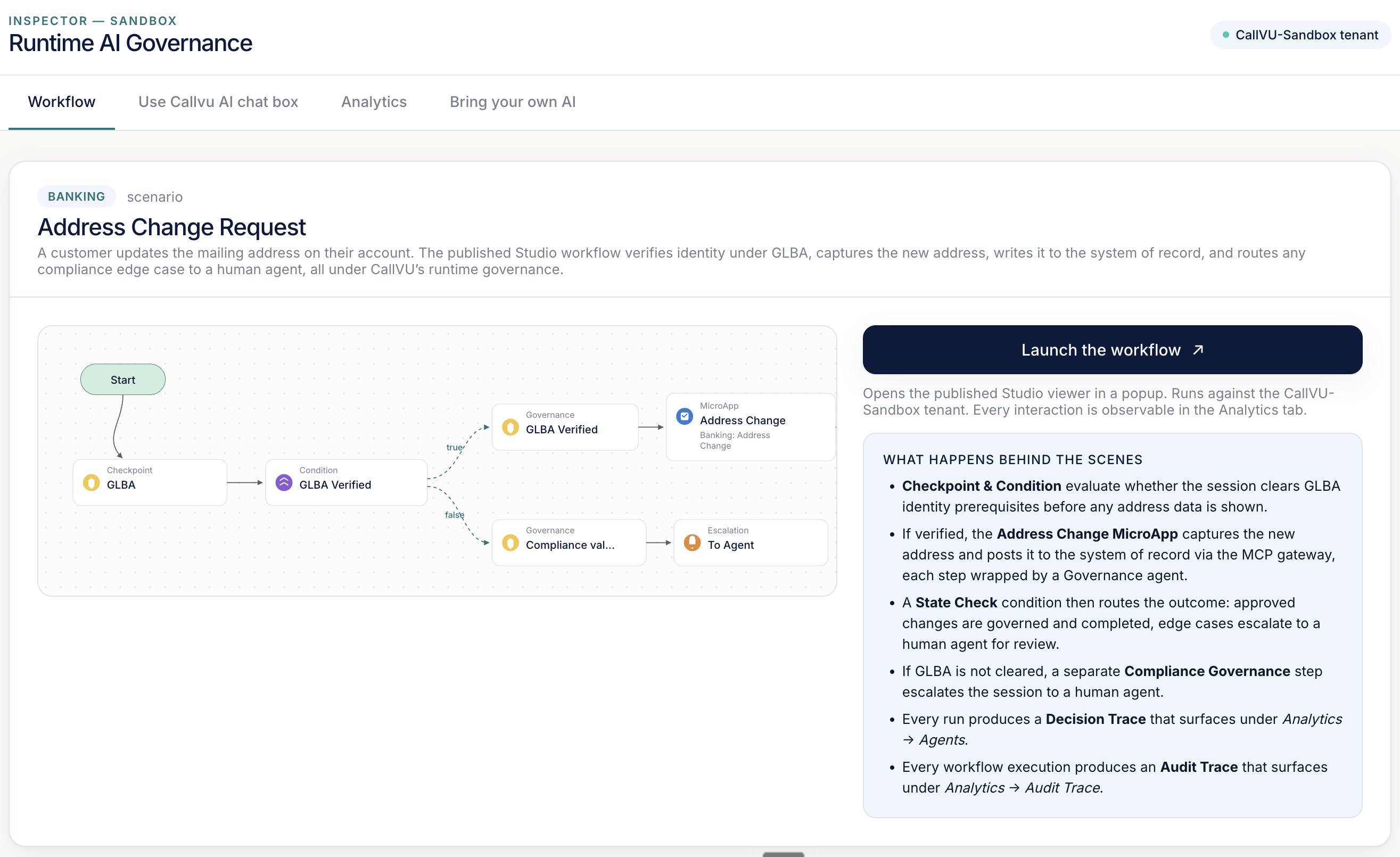
The Inspector running a governed workflow. Every step is enforced at runtime and recorded in the Decision Trace.
Step 1
Request access for your industry
24h approval for evaluators in regulated industries.
Step 2
Unlock your Inspector
Four tabs: run a vertical workflow, chat with Callvu's AI, watch every agent decision, or connect your own AI.
Step 3
Watch the runtime decide. Download the Decision Trace.
Replayable record of every evaluation, decision, and execution.
What this is
The Callvu Sandbox is a live environment that lets you feel runtime AI governance before any sales conversation. Not a demo. Not a simulation. Your AI agent (or ours) invokes a real Callvu workflow against the real runtime. 6 evaluator agents assess in parallel: completion risk, compliance evidence, policy interpretation, data trust, audit readiness, and exception patterns. 1 orchestrator resolves their signals deterministically and issues the execution decision.
You watch all of it happen in the Inspector. Then you download the Decision Trace, a complete replayable record of the invocation context, agent evaluations, orchestrator resolution, and execution outcomes. Hand it to your compliance team. Replay it. Audit it. The receipts you wish your AI stack already produced.
Why it matters
Most AI governance tools review decisions after the AI has already acted. They produce a report. Callvu enforces governance during execution and produces a Decision Trace. The difference: post-hoc review tells you what went wrong; runtime governance prevents it.
If your AI initiative has stalled in pilot because compliance can't validate what your agents will do at scale, this is what that gap looks like solved.
Who this is for
The runtime serves two buyers in regulated AI rollouts.
For AI and technical leaders
You're rolling out AI agents and compliance keeps blocking. You need a runtime layer that enforces what regulated workflows require, not a SOC 2 report after the fact. Open Tab D in the Inspector. Paste the pre-issued Sandbox API key into your AI backend and watch what your AI is now constrained to do. Decision Traces are auditable artifacts your compliance team can finally accept.
For CX ops, compliance and risk leaders
Your business is shipping AI features and you don't have a way to audit what the AI actually does at runtime. Post-hoc reports tell you what happened. Callvu's Decision Trace tells you what was constrained and why, in real time, replayable, evidence-backed. You can tell the auditor exactly what each AI invocation evaluated, decided, and executed.
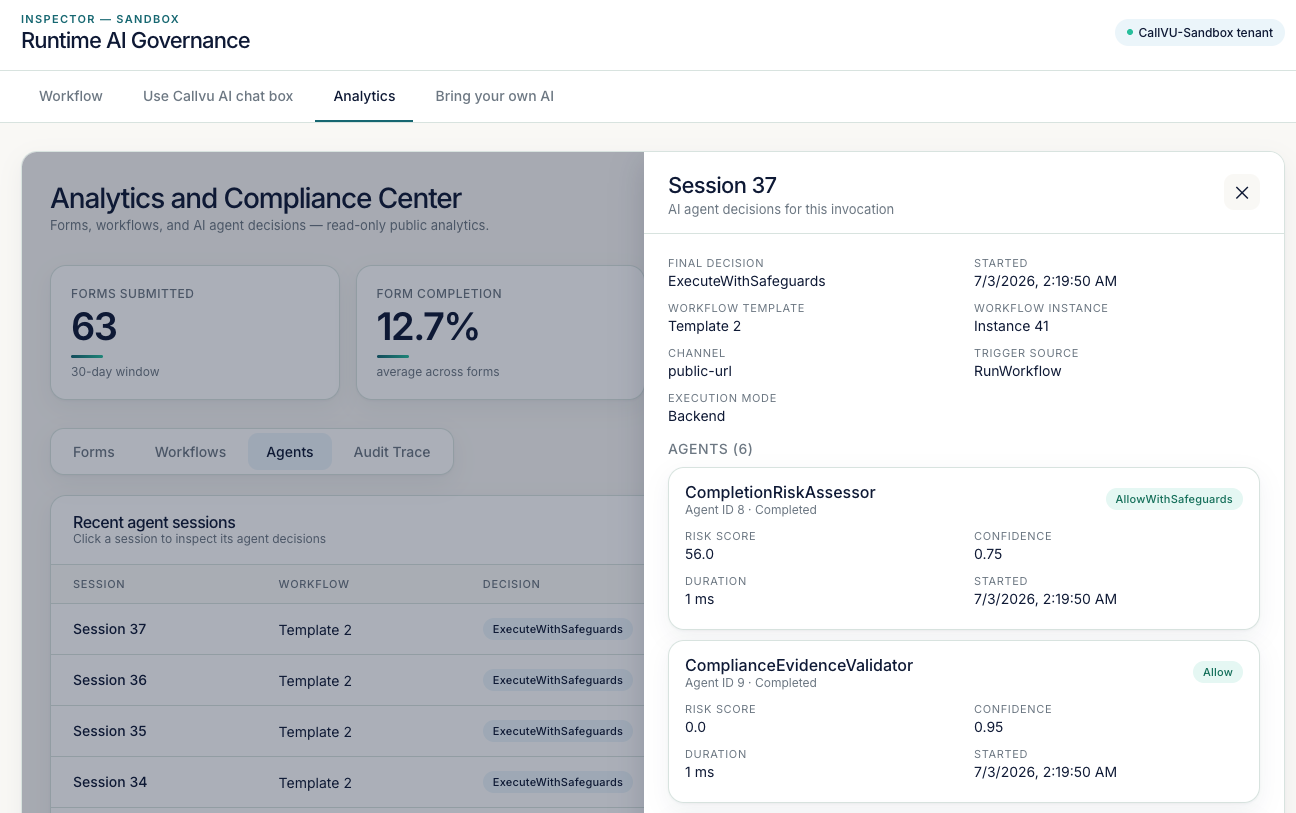
Six evaluator agents assess every invocation. Open any session to see each decision, its risk, and its confidence.
Pick your industry
Each card loads a curated scenario for the chosen vertical.
Banking
Account address change · GLBA
An address change on your account, bound to GLBA. Callvu verifies identity and protects nonpublic information before the runtime writes the new address to the system of record.
Request access →
Insurance
Policy address change · NAIC #668
An address change on your policy, bound to NAIC Model #668. Callvu authenticates the policyholder before the runtime changes nonpublic policy information.
Request access →
Healthcare
Member info and address · HIPAA
A member information and address update, bound to HIPAA. Callvu enforces identity verification and minimum-necessary handling of PHI before the runtime writes the change.
Request access →
Telco
Billing address change · FCC CPNI
A billing address change on your account, bound to FCC CPNI. Callvu authenticates the caller before the runtime accesses or changes account data.
Request access →
Utilities
Service account address change · FCRA Red Flags
An address change on your service account, bound to the FCRA Red Flags Rule. Callvu runs identity verification to stop account-takeover fraud before the runtime writes the change.
Request access →
Travel & eCommerce
Booking refund · Company policy & PCI DSS
A booking refund, bound to the company's own refund and return policy. Callvu enforces that policy at the decision point: approve, apply safeguards, or escalate. Not a statute, by design, and proof the runtime governs internal policy as rigorously as regulation.
Request access →
Mortgage & Lending
Borrower contact update · RESPA
A borrower contact and address update, bound to RESPA. Callvu keeps borrower records accurate and servicing notices correctly routed, verifying identity before the runtime writes the change.
Request access →